

News
Stopping Oil Leaks: Shaft Seal Failures in Rotary Screw Airends

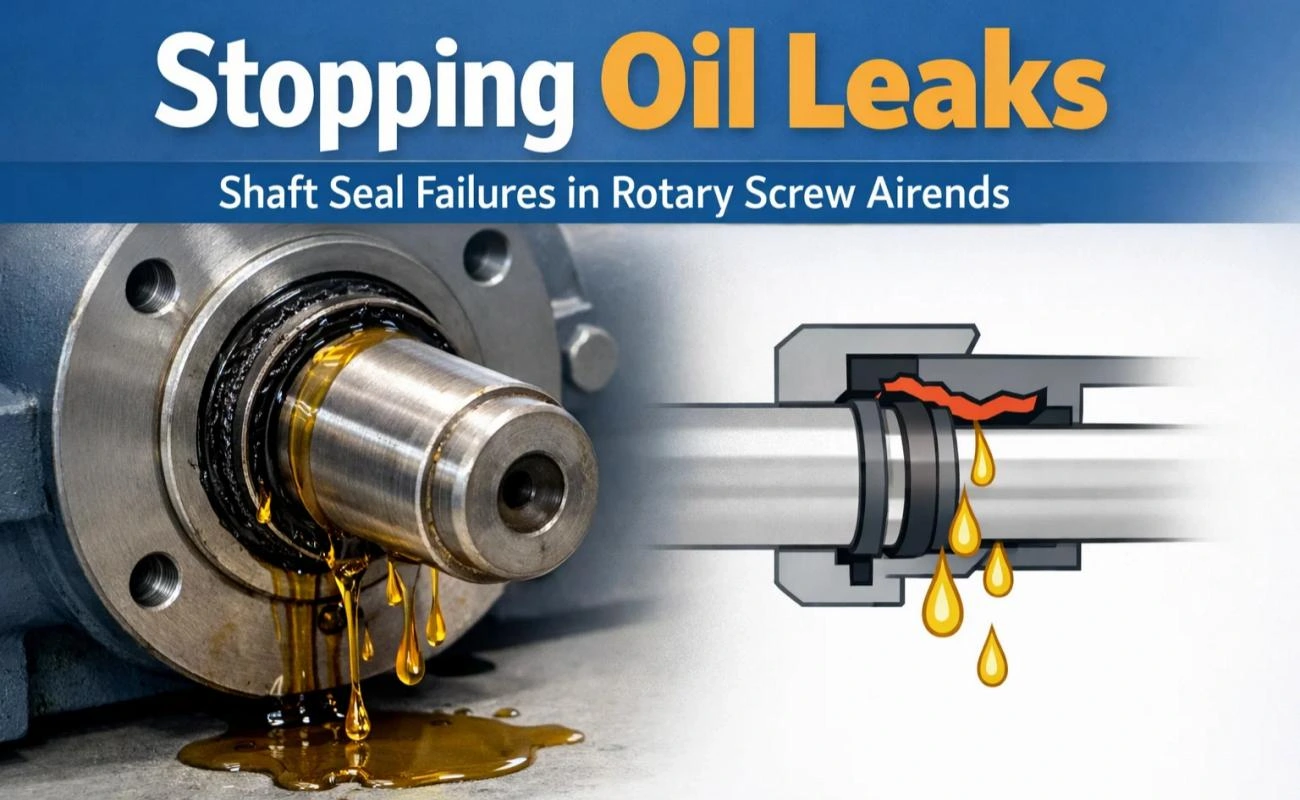
Oil leakage around the drive end of a rotary screw airend is one of the most common issues encountered in compressor maintenance. When this happens, many operators initially suspect serious structural problems—such as casing cracks or internal failures.
In reality, the cause is often far less dramatic but just as critical: wear or failure of the shaft sealing system.
The shaft seal, located at the output end of the airend, plays a key role in preventing lubricating oil from escaping along the rotating shaft. Once this sealing system begins to degrade, oil leakage becomes inevitable. If left unaddressed, it can lead to contamination, increased oil consumption, and even secondary mechanical damage.
Understanding how these seals fail—and how to repair them correctly—is essential for long-term reliability.
The Role of Shaft Seals in Screw Compressors
In oil-injected rotary screw compressors, the airend operates under high pressure and temperature. Lubricating oil is continuously circulated inside the compression chamber to cool, seal, and lubricate the rotors.
The drive shaft, which connects the airend to the motor or gearbox, must pass through the housing. This creates a critical sealing point where oil must be contained while the shaft rotates at high speed.
To achieve this, manufacturers typically use one or a combination of:
- Lip seals (shaft oil seals)
- Labyrinth seals (non-contact sealing structures)
Each type has its own advantages and limitations, particularly under high-speed and high-temperature conditions.
Lip Seals: Simple but Wear-Sensitive
Lip seals are widely used due to their compact design and effective sealing performance. They rely on a flexible sealing lip—usually made of rubber or polymer—that maintains contact with the rotating shaft or shaft sleeve.
This contact creates a physical barrier that prevents oil from leaking.
However, this design also introduces a fundamental limitation: continuous friction.
Failure Mechanisms of Lip Seals
Over time, several factors contribute to lip seal failure:
- Frictional wear
Constant contact with a high-speed rotating surface gradually wears down the sealing lip. - Heat buildup
Friction generates heat, which accelerates material aging and hardening. - Loss of elasticity
As the seal material ages, it loses flexibility, reducing its ability to maintain tight contact. - Surface damage on the shaft sleeve
Even minor roughness or scoring can quickly damage the sealing lip.
Once the sealing lip can no longer maintain consistent pressure against the shaft surface, oil begins to leak.
Labyrinth Seals: Non-Contact but Not Maintenance-Free
Labyrinth seals use a different approach. Instead of direct contact, they rely on a complex path of grooves and chambers to restrict oil flow.
Because there is no friction between the seal and the shaft, labyrinth seals offer:
- Lower wear rates
- Better performance at high speeds
- Reduced heat generation
However, they are not completely immune to problems.
Limitations of Labyrinth Seals
Labyrinth seals depend heavily on:
- Precision machining
- Proper pressure balance
- Clean operating conditions
If internal clearances change due to wear, vibration, or improper assembly, sealing performance can deteriorate. In high-pressure systems, even small deviations can lead to oil leakage.
The Overlooked Component: Shaft Sleeve Wear
One of the most common mistakes in seal replacement is focusing only on the seal itself while ignoring the shaft sleeve.
In many airends, the sealing surface is not the shaft directly, but a replaceable sleeve mounted on the shaft. This sleeve provides a smooth, hardened surface for the seal to run against.
Over time, the sleeve develops wear grooves caused by:
- Continuous friction from the lip seal
- Contaminants embedded in the seal lip
- Micro-vibrations during operation
These grooves may not always be visible at first glance, but they significantly affect sealing performance.
Why Replacing Only the Seal Is Not Enough
If a new lip seal is installed on a worn sleeve:
- The sealing lip cannot maintain uniform contact
- Oil bypasses through worn grooves
- Leakage quickly reappears
This leads to a common scenario where a “new” seal fails within a short period.
For this reason, replacing the shaft sleeve together with the seal is essential for a proper repair.
Practical Replacement Considerations
Replacing shaft seals in rotary screw airends is not a trivial task, especially in high-pressure systems.
Technicians should pay attention to:
- Surface Condition
Ensure the shaft sleeve is smooth, free of scoring, and within tolerance. If not, replace it. - Installation Accuracy
Improper alignment during installation can cause uneven seal wear and premature failure. - Lubrication During Assembly
Applying appropriate lubrication helps prevent dry friction during initial startup. - Clean Working Environment
Contaminants introduced during assembly can damage the new seal immediately.
Preventing Future Oil Leakage
To extend the life of shaft seals and sleeves, operators should:
- Maintain proper oil quality and cleanliness
- Replace filters regularly to prevent contamination
- Monitor vibration levels to reduce mechanical stress
- Avoid excessive operating temperatures
These measures help reduce wear on both seals and shaft surfaces.
Conclusion: A System, Not Just a Seal
Oil leakage at the airend shaft is rarely caused by a single component failure. It is typically the result of interacting factors—seal wear, surface degradation, and operating conditions.
Focusing only on replacing the lip seal without addressing the shaft sleeve is a short-term fix at best. A complete solution requires understanding the entire sealing system and restoring all critical contact surfaces.
In compressor maintenance, effective sealing is not about replacing parts—it is about restoring the integrity of the system as a whole.