

News
Preventing Oil Backflow: The Critical Role of Check Valves During Shutdown

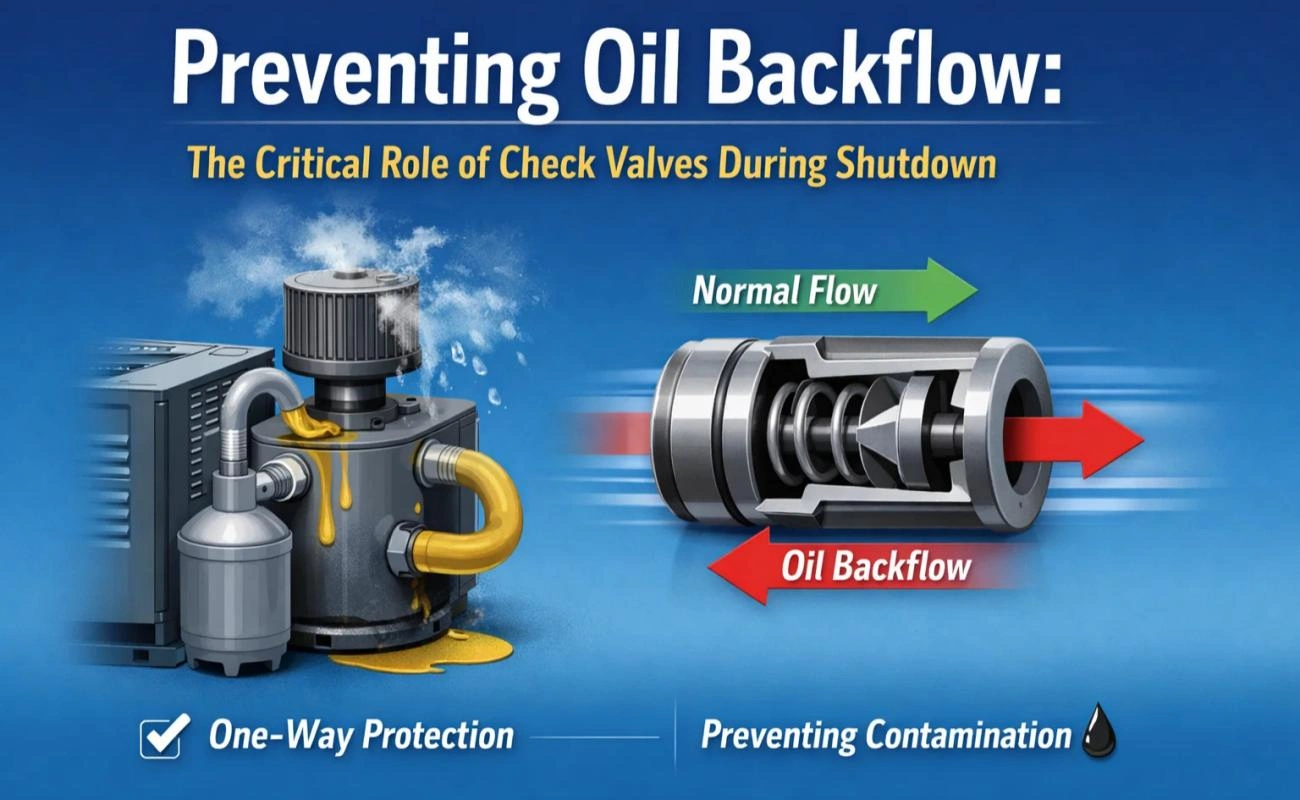
Some compressor problems only appear after the machine stops running. Operators may notice oil mist around the air filter housing, oil traces in the intake line, or even visible oil spray during shutdown. These symptoms are often misattributed to separator failure or excessive oil level. In many cases, however, the real cause is much simpler—and more mechanical: a failing check valve.
Though small in size, the check valve plays a decisive role in controlling airflow direction. When it loses sealing integrity, pressure reverses inside the system, leading to oil backflow and contamination. Understanding this “one-way” component is key to preventing unnecessary repairs and protecting system cleanliness.
What Does a Check Valve Do in a Compressor System?
A check valve, also called a non-return valve, ensures that compressed air flows in only one direction. In oil-injected screw compressors, check valves are typically installed:
- At the discharge outlet
- Between separator tank and system pipeline
- In oil return lines (depending on design)
During normal operation, compressed air pushes the valve open, allowing flow to the plant network. When the compressor shuts down, internal pressure drops. The check valve should immediately close, preventing pressurized air from flowing back into the compressor.
This simple function protects multiple components simultaneously.
Why Backflow Becomes a Problem
When a check valve fails to seal properly, residual pressure from the air network can reverse into the compressor after shutdown.
This reverse pressure can:
- Force oil back toward the airend
- Push oil mist toward the intake system
- Create pressure imbalance inside the separator tank
- Cause oil to discharge through the inlet during unloading
Operators often describe this as “shutdown oil spray” or “oil blowing from the intake.”
This phenomenon is not only messy—it signals internal pressure instability.
The Typical Scenario: Shutdown Oil Spray
A common complaint in industrial settings is:
“Every time we stop the compressor, oil spits out near the air filter.”
Here’s what usually happens mechanically:
- Compressor stops.
- Internal pressure begins to drop.
- System pipeline still holds higher residual pressure.
- Faulty check valve fails to close tightly.
- Pressurized air flows backward into the separator tank.
- Oil is pushed toward the inlet path.
If the inlet valve is partially open or not fully sealed during unloading, oil mist may escape through the intake assembly.
The root cause is often not the separator element—but reverse pressure.
Why Check Valves Fail
Check valves operate under continuous pressure cycles. Over time, several failure modes may develop:
Seal wear
Rubber or polymer sealing surfaces degrade under heat and oil exposure.
Valve core deformation
Repeated pressure impact can damage the valve disc or poppet.
Spring fatigue
Weak springs prevent tight closure.
Contamination buildup
Carbon deposits or debris prevent proper sealing.
Even small imperfections in the sealing surface can allow gradual leakage, leading to pressure backflow.
Secondary Risks of Ignoring the Problem
Beyond oil spray, a leaking check valve can cause:
- Loaded startup conditions
- Increased motor starting current
- Shortened separator life
- Higher oil consumption
- Pressure instability
Repeated loaded starts are particularly harmful to motors and drive systems. What appears to be a minor sealing issue can evolve into a larger mechanical problem.
How to Diagnose Check Valve Problems
Practical diagnostic steps include:
- Observing pressure gauge behavior after shutdown
- Listening for air flow sounds in reverse direction
- Monitoring separator tank pressure retention
- Inspecting intake area for oil residue
- Disassembling and visually inspecting valve core and seals
If pressure equalizes too quickly between system and compressor after shutdown, the check valve likely requires attention.
Repair or Replace?
In some cases, replacing only the sealing ring or valve core restores performance. However, if the valve seat is worn or corroded, complete valve replacement is recommended.
High-quality replacement components offer:
- Precision-machined sealing surfaces
- Oil-resistant sealing materials
- Proper spring tension calibration
- Longer service intervals
Given the relatively low cost of check valves compared to separator systems or airend repairs, timely replacement is a cost-effective preventive measure.
Why Component Quality Matters
In compressed air systems, even minor leakage can create cascading effects. Inferior valve materials may initially function but degrade quickly under temperature and oil exposure.
Choosing durable valve cores and high-grade sealing elements ensures:
- Stable shutdown behavior
- Reduced oil contamination
- Lower maintenance frequency
- Improved system reliability
For industrial operators, investing in quality check valves protects both equipment and operating efficiency.
Conclusion: A Simple Valve with System-Wide Impact
The check valve is essentially the “one-way gate” of your compressed air system. When functioning correctly, it prevents pressure reversal and protects internal components. When it fails, symptoms appear quickly—and often dramatically.
If shutdown oil spray or backflow issues occur, checking the check valve should be one of the first diagnostic steps.
In compressor systems, maintaining airflow direction is not optional—it is fundamental to mechanical stability and cleanliness.