
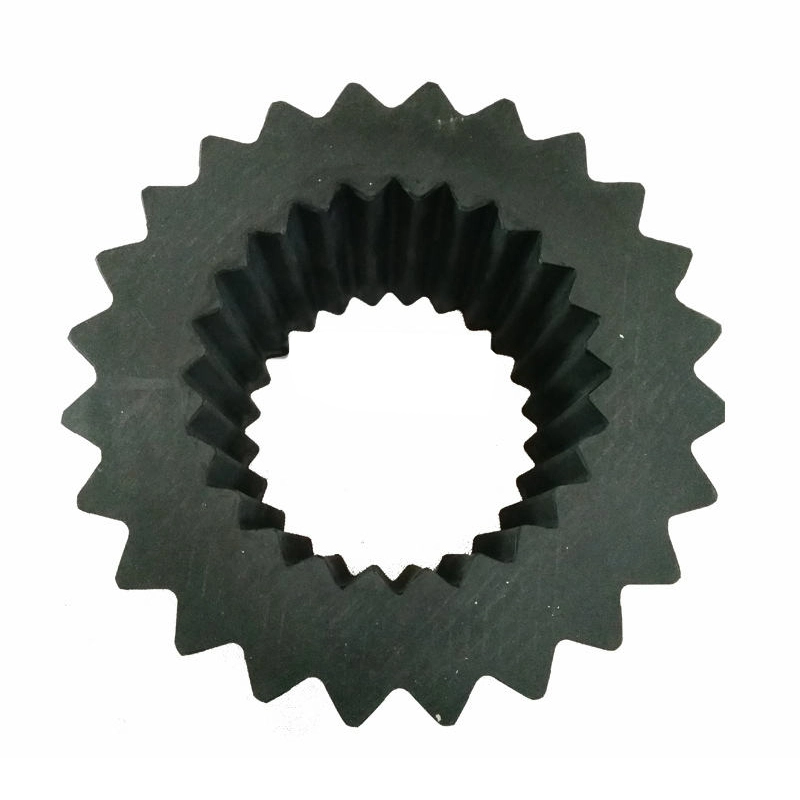
Atlas Copco Air Compressor Parts Flexible Rubber Coupling

These rubber couplings are engineered for Atlas Copco screw compressor drive systems, designed to stabilize torque transfer, control torsional oscillation, and protect rotating elements under continuous load. Manufactured from high-resilience elastomers and dimensioned to OEM standards, models 1613960901, 1613982300, and 1614873800 ensure reliable and quiet operation across demanding industrial environments.

Application

Air Compressor

Material

rubber

Category: Tag:
Description

In a screw compressor, the motor and airend operate as a tightly linked rotating system. Any disturbance—misalignment, load fluctuation, or torque ripple—directly affects bearings, rotors, and drive shafts. These rubber couplings are designed to act as a buffer within this system, absorbing and stabilizing dynamic movement to ensure smooth, predictable operation.

The three models listed above share the same design purpose but cover different compressor configurations and power ranges. Their elastomer bodies are shaped to maintain torsional balance during rotation while preventing excessive transmission of high-frequency vibration from the airend back to the motor.

They serve as essential protective components that safeguard both the prime mover and the airend from long-term mechanical stress.

Material Engineering & Internal Structure

To achieve consistent torsional performance, each coupling is manufactured using a premium elastomer compound formulated for both rebound elasticity and shear resistance. The material is engineered to withstand repeated twisting cycles, which are typical in screw compressors due to pressure variations inside the airend.

Internally, the couplings feature a multi-segment energy-absorbing architecture. Instead of a single solid rubber block, the geometry strategically distributes load outward from the rotational center. This ensures that the coupling no longer relies solely on surface hardness for performance; it uses controlled deformation to manage torque peaks without overstressing the material.

The elastomer’s polymer chains are reinforced through precision curing, which enhances fatigue resistance and reduces the risk of micro-cracking—a common cause of failure in generic couplings.

Operational Performance & Advantages

These couplings excel in dynamic environments where torsional fluctuation is unavoidable. Their key performance strengths include:

  1. Stable Torque Transmission
    The coupling maintains uniform torque transfer even when operating near full compressor capacity. Its deformation remains linear across the load range, preventing abrupt energy release or rebound effects that could destabilize the drivetrain.
  2. Effective Misalignment Compensation
    Machines inevitably shift during heating and cooling cycles. These couplings tolerate small angular and radial deviations without generating additional noise, vibration, or shaft loading.
  3. Heat & Compression Stability
    Inside screw compressors, ambient temperatures can rise significantly. The elastomer formulation resists thermal hardening, ensuring that flexibility and damping characteristics remain stable over time.
  4. Reduced Bearing and Rotor Stress
    By limiting torsional shock, the coupling indirectly extends the service life of the motor bearings, airend bearings, and drive shafts.

The result is a quieter, smoother, and more predictable compressor operating condition.

Compatibility with Atlas Copco Systems

Models 1613960901 / 1613982300 / 1614873800 are designed for use in specific Atlas Copco compressor platforms, including multiple GA and GR series rotary screw units. Dimensional fitment, torque characteristics, and alignment tolerances correspond precisely to original Atlas Copco specifications.

They install directly without requiring adjustment to the motor or airend connection hubs, ensuring seamless replacement during scheduled maintenance.

Manufacturing Process & Quality Control

Each coupling undergoes a tightly regulated production cycle:

  • Elastomer mixing and compound stabilization
  • Controlled injection molding to preserve dimensional consistency
  • Multi-stage vulcanization for optimal bond strength
  • Precision trimming and surface finishing
  • Torsional endurance testing under variable load
  • Hardness, density, and concentricity inspection

Only couplings that pass all mechanical and dynamic tests are approved for shipment, ensuring reliability during long-term compressor operation.

OEM Reference Numbers

These rubber couplings replace and correspond to the following Atlas Copco OEM part numbers:

  • 1613960901
  • 1613982300
  • 1614873800

Maintenance & Service Notes

Even high-grade couplings experience fatigue from repeated torsional stress. During routine compressor servicing, check for:

  • Radial cracking or surface stiffening
  • Excessive vibration during startup
  • Irregular noise during load changes
  • Visible deformation or heat glossing

Replacing the coupling at the correct interval prevents secondary damage such as bearing overload, motor vibration, or shaft misalignment issues.

For best results, ensure proper alignment during installation and confirm that mounting hubs are clean and free of debris.

Shipping and Delivery

MAECENAS IACULIS

Vestibulum curae torquent diam diam commodo parturient penatibus nunc dui adipiscing convallis bulum parturient suspendisse parturient a.Parturient in parturient scelerisque nibh lectus quam a natoque adipiscing a vestibulum hendrerit et pharetra fames nunc natoque dui.

ADIPISCING CONVALLIS BULUM

  • Vestibulum penatibus nunc dui adipiscing convallis bulum parturient suspendisse.
  • Abitur parturient praesent lectus quam a natoque adipiscing a vestibulum hendre.
  • Diam parturient dictumst parturient scelerisque nibh lectus.

Scelerisque adipiscing bibendum sem vestibulum et in a a a purus lectus faucibus lobortis tincidunt purus lectus nisl class eros.Condimentum a et ullamcorper dictumst mus et tristique elementum nam inceptos hac parturient scelerisque vestibulum amet elit ut volutpat.