News
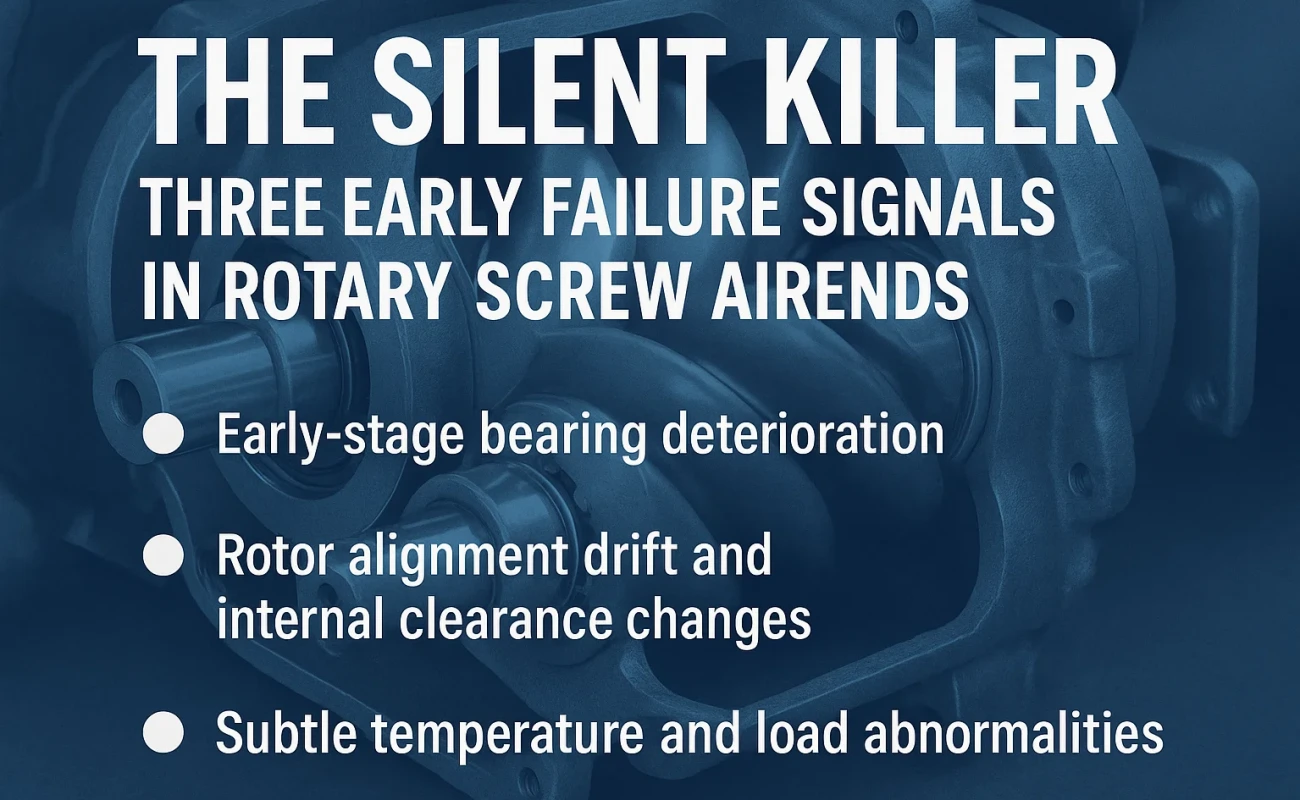
The Silent Killer: Three Early Failure Signals in Rotary Screw Airends
In most rotary screw air compressors, the airend is the single most expensive and mission-critical component. It is also the one most likely to fail silently. Long before catastrophic damage occurs—whether it is rotor scoring, bearing collapse, or complete seizure—the airend typically sends out subtle warning signals. Unfortunately, these signals often go unnoticed during daily operation. By the time noise becomes obvious or temperature spikes trigger alarms, the internal damage is usually irreversible.
This article focuses on three pre-failure indicators that experienced technicians monitor closely:
- Early-stage bearing deterioration,
- Rotor alignment drift and internal clearance changes, and
- Subtle temperature and load abnormalities caused by efficiency loss.
Recognizing these signals early can prevent unexpected downtime, production loss, and costly airend rebuilds.
Bearing Pre-Failure Indicators: The Earliest—and Most Overlooked—Warning
Airend bearings are designed to handle high rotational speeds, heavy axial thrust, and continuous operation. Yet even the highest-grade bearings degrade gradually due to lubrication breakdown, contamination, and thermal cycling.
What makes bearing failure so dangerous is that early deterioration is almost silent.
Key early signs of bearing degradation
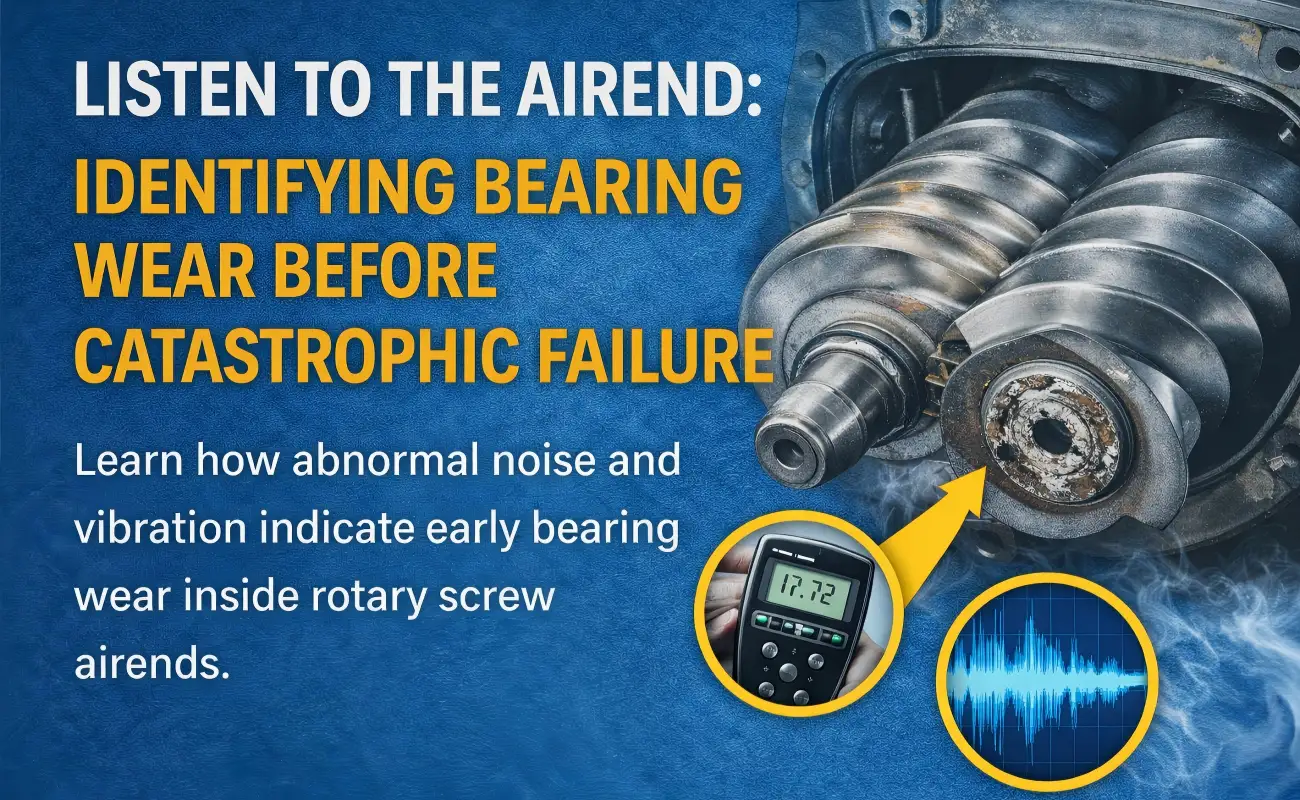
Microscopic vibration increase (before audible noise appears)
High-frequency vibration develops long before operators hear abnormal sound. This occurs when:
- The cage begins to loosen,
- Rolling elements experience micro-spalling, or
- Lubrication film becomes inconsistent.
Even slight increases in vibration amplitude or frequency peaks—especially in the 1× or 2× rotational band—indicate bearing fatigue.
Rising oil particle count
Wear debris is the first physical evidence of bearing deterioration. Increased metal particles in the oil filter or separator tank suggest inner race or roller wear.
Subtle changes in axial thrust load
If the thrust bearing begins to lose structural integrity, it can shift axial loading toward the rotor set. This causes efficiency changes that many operators misdiagnose as modulation or inlet issues.
Why bearings deteriorate faster in real-world use
- Incorrect oil viscosity or oxidation
- Overheated oil reducing lubrication film
- Moisture entering the oil circuit
- Frequent start-stop cycles
- Poor-quality separator elements causing pressure imbalance
Bearings rarely fail instantly—they announce it. The challenge is noticing it.
Rotor Alignment Drift: When Clearance Changes Become the Silent Enemy
Rotors rely on extremely precise clearances—sometimes measured in microns—to maintain compression efficiency. When these clearances change, the airend loses efficiency long before a major failure occurs.
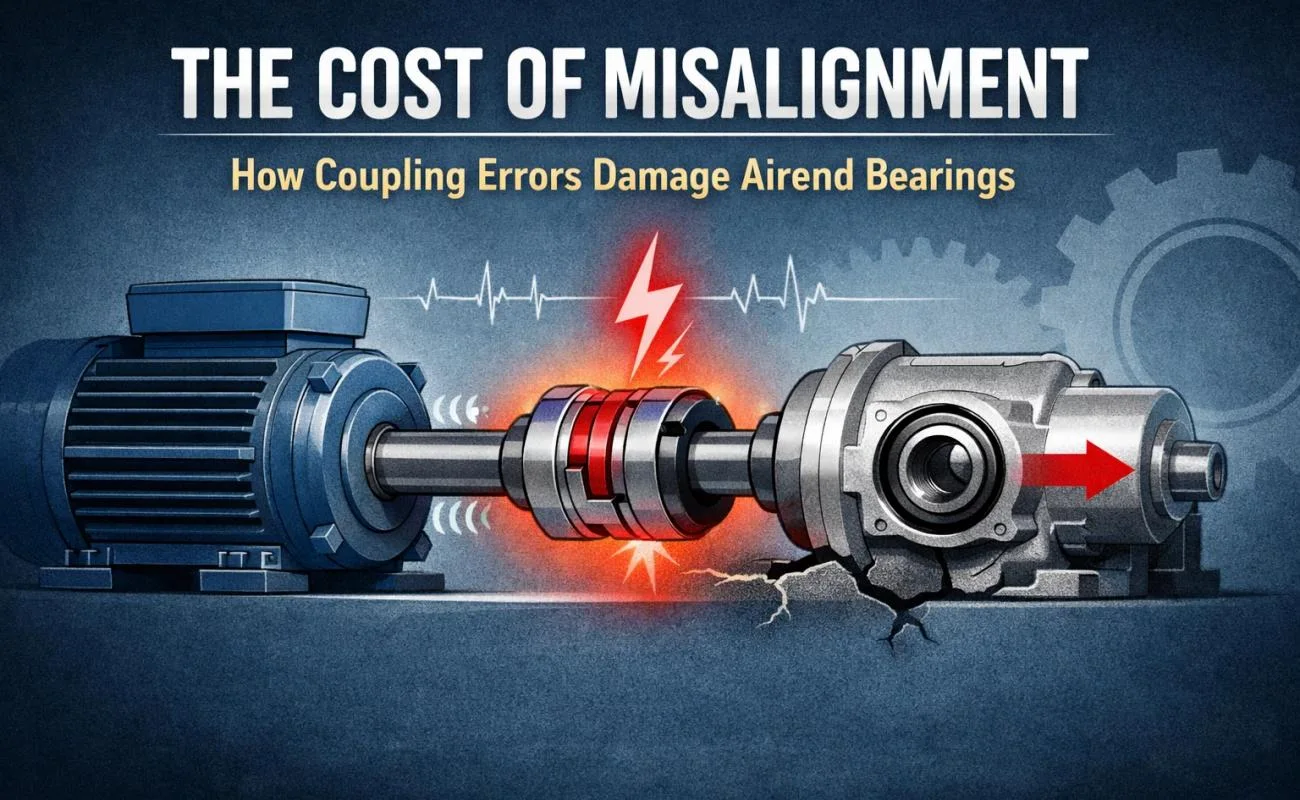
The most common cause is alignment drift between the male and female rotors. This can result from bearing wear, housing distortion, or excessive heat cycles.
Early symptoms of rotor alignment issues
- Gradual drop in FAD (free air delivery)
Operators may notice the compressor takes longer to reach working pressure or loads more frequently. This is often misdiagnosed as inlet valve problems, but the root cause may be rotor inefficiency. - Increased power consumption at the same load
If the rotors lose their sealing effectiveness, the compressor must work harder to produce the same airflow. - Slight temperature rise in discharge—even without alarms
A 5–10°C increase may not trigger shutdown, but it indicates reduced volumetric efficiency. - Fine metallic dust around the airend cavity
If internal rub occurs—even momentarily—the wear debris will appear as metallic powder in the lubricant circuit.
Alignment drift is silent, progressive, and expensive. Once the rotor surfaces touch, the damage spreads quickly.
Temperature and Load Abnormalities: The System-Level Clues
Many technicians rely too heavily on pressure readings. In reality, temperature and load are far more reliable indicators of airend health.
When rotors wear or bearings begin to fail, the compressor compensates automatically. These compensations show up in subtle performance changes.
Look for these early-stage abnormalities
- Higher running temperature under normal environmental conditions
This signals declining compression efficiency. Even a small shift—say from 82°C to 88°C—should prompt inspection. - Modulation behavior becomes irregular
If load/unload cycles become shorter or longer than usual, the airend may be experiencing internal leakage or efficiency loss. - Motor amp draw rises slowly over weeks or months
A steady upward trend often indicates increased rotor drag or bearing friction. - Delayed pressure recovery after unloading
When rotors lose sealing quality, the compressor struggles to rebuild pressure, even if the inlet valve and MPV operate normally.
These symptoms rarely appear suddenly—they evolve. Tracking weekly trends is key to identifying issues early.
The Cost of Ignoring Early Signals
A failed airend can cause:
- Complete production stoppage
- Expensive rebuilds or replacement units
- Contamination of downstream equipment
- Unexpected oil carry-over incidents
- Catastrophic rotor or housing damage
But most failures could have been avoided by catching the early warning signs.
How to Protect the Airend from Pre-Failure Damage
A few best practices dramatically improve detection and reliability:
- Trend vibration and temperature, not just snapshots
- Use high-quality lubricating oil appropriate for your climate
- Replace separators and oil filters on schedule
- Monitor metal particle content
- Perform periodic bearing and rotor clearance checks
- Avoid excessive start-stop cycles
- Keep cooling systems clean to reduce thermal stress
Good airend health is never a matter of luck—it is a matter of early detection and correct intervention.